
Publicly-funded research projects

Cancel
  • CellXPress

    Research project: “CellXPress - Accelerated and Harmonized Scaling of Battery Materials and Cells”

    The “CellXPress” project is developing an accelerated scaling concept to efficiently transfer innovative battery materials from the laboratory scale to the production of large-format cells. To this end, material scaling at the ZSW PowderUp technical center and cell manufacturing at Fraunhofer FFB’s PreFab facility are closely integrated and supplemented by digital methods. The goal is to accelerate the transfer of new material concepts, reduce development risks, and thereby strengthen a competitive battery value chain in Germany and Europe.

    more info
  • UVPolyZell

    Research project: “UVPolyZell - Fluorine‑free polymeric binders for lithium‑ and sodium‑ion batteries”

    The “UVPolyZell” project is developing a novel polymer binder system for lithium-ion batteries with NMC cathodes that does not require toxic solvents such as NMP or fluorine-based polymers such as PVDF. The goal is to scale the material system to near-production levels and significantly reduce the energy required for electrode drying. UV-induced polymerization, along with innovative mixing and additive concepts, is intended to enable more sustainable and energy-efficient electrode production.

    more info
  • PressureBat

    Research project: “PressureBat -Optimization of the production process for prismatic battery cells using cell-integrated pressure sensors ”

    The “PressureBat” project involves the development of flat pressure sensors that are integrated into battery cells to measure mechanical stresses inside the cells with spatial resolution along the entire process chain. The focus is on establishing internal cell pressure as a new quality parameter, as well as reducing scrap, improving process control, and enhancing the quality, safety, and service life of lithium-ion batteries.

    more info
  • BEST-BAT

    Research project: “BEST-BAT - Assessment of the potential for self-sufficiency and the techno-economic suitability of battery technologies for future-oriented applications”

    The “BEST-BAT” project is developing a holistic evaluation methodology to support stakeholders in the battery ecosystem in selecting suitable battery cells and technologies. Technical, economic, and environmental criteria are linked to the requirements of future-oriented applications and made accessible through an interactive, web-based application. The goal is to strengthen knowledge transfer and collaboration along the value chain, accelerate the electrification of various application areas, and tap into the potential of second-life batteries and alternative battery technologies.

    more info
  • HEPAD

    Research Project, “HEPAD - High Efficiency Payload Arial Drone”

    The “HEPAD” project is developing a highly efficient transport drone with a performance-optimized powertrain and innovative battery architecture. The goal is to significantly increase range, flight time, payload, and efficiency for inner-city and short-distance logistics applications.

    more info
  • VULCAN

    Research Project, “VULCAN - Versatile Ultra-thin Layer Coating and Architecture for NEVs”

    The “Vulcan” project is developing innovative coating and production technologies for higher-performance lithium-ion batteries. By using a novel curtain coating process, the project aims to achieve higher energy densities and improved fast-charging capabilities. In this way, the project helps strengthen the competitiveness of the European battery industry and reduce strategic dependencies in the areas of energy supply and mobility.

    more info
  • InnoAktiv

    Research project: “Development and Demonstration of Material, Process, and Equipment Innovations in Cell Activation for Battery Cell Production”

    The “InnoAktiv” project is developing and testing innovative materials, processes, and equipment technologies to accelerate cell activation in lithium-ion batteries. The focus is on significantly reducing activation time as well as lowering energy consumption, costs, and emissions.

    more info
  • FELKON

    Research Project, “FELKON - Error Detection, Machine Learning, and Correlation for Sustainability”

    In the »FELKON« project, innovative digital and imaging technologies are being developed for the early detection of defects in battery cells. The aim is to reduce production scrap and material consumption, improve the quality and lifetime of battery cells, and thereby strengthen competitive and sustainable battery cell manufacturing in Germany and Europe.

    more info
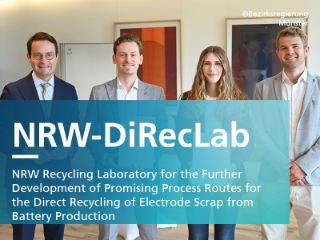
  • NRW-DiRecLab

    Research project, »NRW Recycling Lab for Advancing Direct Recycling Routes of Electrode Scrap from Battery Production«

    In the »NRW-DiRecLab« project, the Fraunhofer FFB (Münster) and PEM (RWTH Aachen University) are establishing a research infrastructure – unique in Germany and Europe – for the direct recycling of electrode scrap from battery cell production. PEM will host a modular, flexible laboratory-scale environment, while Fraunhofer FFB will set up a scaled pilot-scale process route (vacuum comminution, supercritical CO₂ extraction, vibrating screen) plus complementary analytics and cell testing infrastructure. Five promising process routes with different delamination methods – thermal, solvent-based (optionally ultrasound-assisted), mechanical and scCO₂-based – will be investigated. The goal is to recover high-quality active materials, reintegrate them into cell manufacturing and thus close local material loops.

    more info
  • SmartBMS

    Research Project: “Smart Battery Management System and Intelligent Data Analysis in the Cell Production Process”

    The “SmartBMS” project is developing and validating innovative methods for optimizing battery management systems for lithium-ion batteries. The goal is to increase production and operational efficiency, reduce scrap, and improve the performance and service life of battery systems.

    more info