Press releases

Please contact us for press enquiries, further information about the Fraunhofer FFB or if you are looking for contact persons for our studies.

Cancel
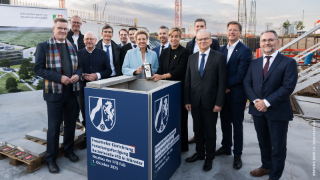
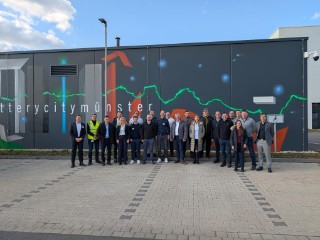
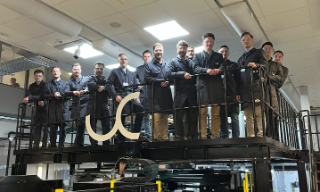
  • In recent years, Münster has developed into one of Europe’s leading battery hubs. Jochen Ott, Chair of the SPD parliamentary group in the North Rhine-Westphalia State Parliament, and Sven Frenck, SPD candidate for the State Parliament in Constituency III in Münster, got a firsthand look at the contri-bution made by the Fraunhofer Institute for Battery Cell Research and Pro-duction (FFB) during a visit to the Münster-Amelsbüren site. Dr.-Ing. Florian Degen, head of the Production Technology Department at Fraunhofer FFB, guided the guests through the “FFB PreFab” research production facility and provided insights into industry-oriented battery cell production.

    more info
  • Study Identifies Strategic Gaps in the Battery Startup Ecosystem / 2026

    Startup Boom Not Reaching All Sectors of the Battery Industry

    July 27, 2026

    Startups are considered drivers of the energy transition. A study by the University of Münster and Fraunhofer FFB now shows that battery startups are emerging primarily in areas where technological expertise is in demand but capital requirements are still manageable. Startups are particularly well-represented in advanced materials, specialized components, and cell manufacturing. By contrast, significantly fewer startups are emerging in more capital-intensive areas of the value chain, such as raw material extrac-tion, recycling, or second-life applications. Even where startups do emerge, the transition to industrial-scale production often remains a major hurdle. For the study, the research team analyzed more than 400 new battery companies worldwide. The results were published in the journal „Energy Strategy Reviews“.

    more info
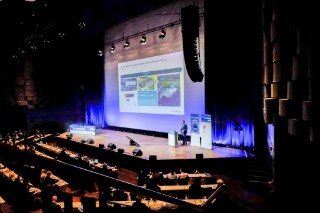
  • By 2030, the volume of end-of-life batteries and materials to be recycled is expected to triple. At the same time, the complexity of return streams is increasing, for exam-ple due to different battery types, designs, and chemical compositions. A joint study by the Fraunhofer Research Institution for Battery Cell Production FFB, the Institute of Business Chemistry at the University of Münster, Porsche Consulting GmbH, and Volkswagen AG shows that, for recycling companies, the key priorities now are to scale up existing recycling processes in an economically viable manner and to pre-pare in a timely manner for the significantly more diverse return streams of the fu-ture. The results have now been published in the world-renowned journal “Nature Energy.”

    more info
  • The Fraunhofer Research Institution for Battery Cell Production FFB is once again strengthening the transfer of research into industrial applications: The institute’s third spin-off project is already in the starting blocks. To this end, Professor Achim Kampker is moving from the institute’s leadership to the newly formed company and will focus in the future on building it up to produce semi-finished products and battery cells in close collaboration with Fraunhofer FFB. Prof. Jens Tübke and Prof. Simon Lux will continue to lead Fraunhofer FFB.

    more info
  • Mayor, Municipal Utilities, and Fraunhofer FFB Commission Agri-Solar Park / 2026

    From the cornfield to battery research

    May 22, 2026

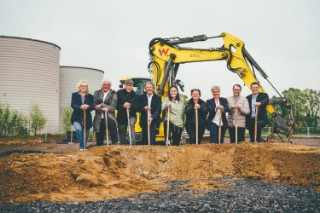
    From now on, a field in Hartmannsbrook, Amelsbüren, will no longer be used solely for grow-ing grain: a new agri-solar plant will also generate solar power on the site. Mayor Tilman Fuchs, along with representatives from Stadtwerke Münster and Fraunhofer FFB, gathered at the solar park for the official commissioning. “This project shows what is possible when a city works together on its future. Business, agriculture, Stadtwerke, and citizens are all pulling together here and demonstrating their ability to shape Münster’s future,” emphasized Mayor Tilman Fuchs.

    more info
  • Industrial battery cell manufacturing has become a key strategic issue for Europe’s competitiveness. Against this backdrop, Institute Director Prof. Simon Lux will discuss key challenges and prospects for European battery cell manufacturing with representatives from industry and politics at the world’s leading industrial trade fair. In addition, Fraunhofer FFB will demonstrate how applied research, digital production concepts, and connected factory solutions accelerate the transfer of research results to an industrial scale.

    more info
  • 25 industry and research partners are developing a sustainable, cost-effective alternative to lithium-ion technologies / 2026

    Major BMFTR Project on Sodium-Ion Battery Cell Manufacturing in Germany Has Begun

    Press release  / March 31, 2026

    With the SIB:DE ENTWICKLUNG funding project, the Federal Ministry of Research, Technology, and Space (BMFTR) is launching the largest German consortium to date dedicated to sodium-ion battery technology. Twenty-five partners from academia and industry are collaborating to develop a sustainable, safe, and cost-effective alternative to lithium-ion batteries. The focus is on the production of large-format, market-ready cells as well as the assessment of recyclability. The goal is the rapid transfer of research results into industrial applications.

    more info
  • Lithium and sodium-ion technologies are more closely linked than assumed / 2026

    Study shows: "Switching to a new battery technology does not automatically open the door to new market players"

    Press release / February 24, 2026

    © Adobe Stock / von จิรวัฒน์ ขันเงิน

    Researchers used AI-supported patent analysis to show how strongly battery technologies build upon one another. The findings suggest that industrial and innovation strategies must account for these technological dependencies far more rigorously.

    more info
  • Syvairo receives exist Start-up grant for innovative intralogistics solutions in battery cell production / 2026

    Syvairo receives exist Start-up grant for innovative intralogistics solutions in battery cell production

    Press release / February 04, 2026

    In European battery cell production, large-scale cleanrooms and dry rooms create significant cost disadvantages compared to Asian competitors. The startup initiative Syvairo addresses this challenge with a patented intralogistics solution known as a mobile mini-environment, achieving a reduction in energy consumption of more than 50 percent. With funding approved under the EXIST Research Transfer programme of the German Federal Ministry for Economic Affairs and Energy, the spin-off from Fraunhofer FFB is now transferring this technology into industrial application, paving the way for competitive battery production “Made in Germany.”

    more info